
Educational only. This page is for study and due diligence. It is not legal advice about what you should or should not do. Nothing here is a prescription to break any law. Verify every claim for yourself before you act on any strategy. Laws and procedures vary by place.
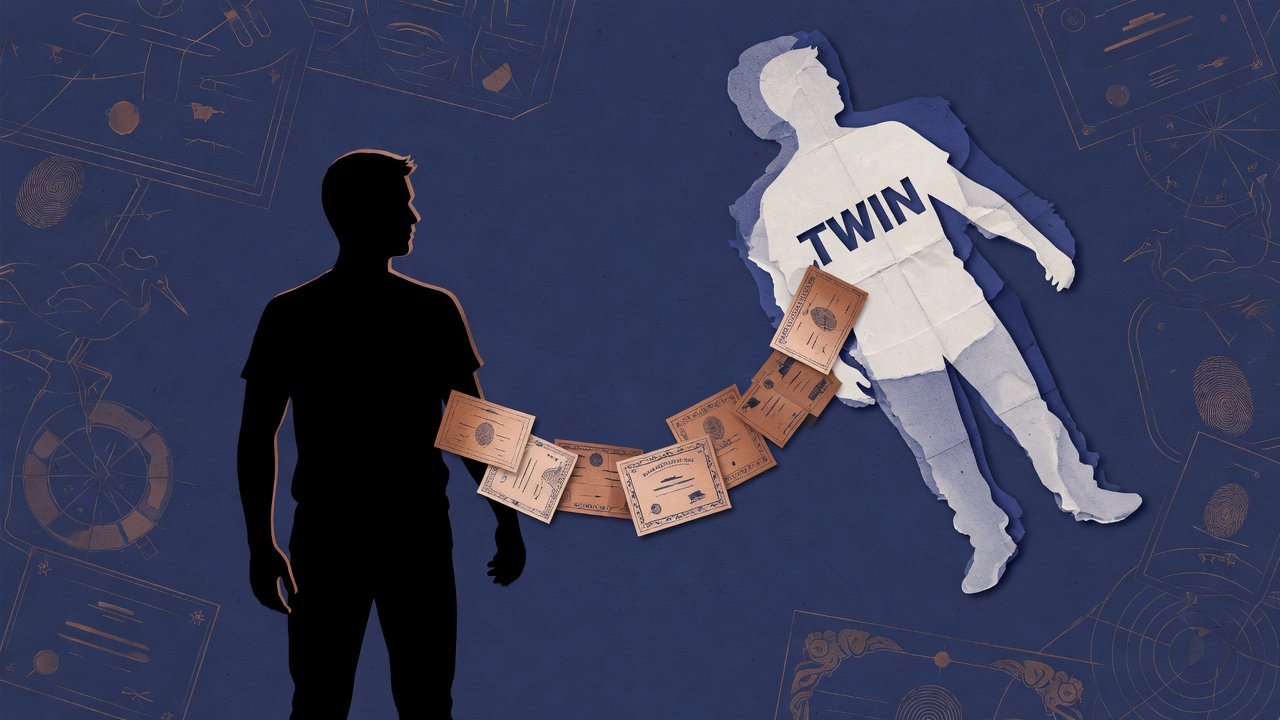
As a child you may have had an imaginary friend. Evidence suggests that, from the moment a birth certificate was filed for you, you also gained a make-believe twin—not flesh and blood, but artificial. That twin is a straw man: a front, a façade, a “persona” (the root sense behind the word person). In commercial and property settings, a straw man is a nominal third party put up in name only to take part in a transaction—sometimes only so a transfer can be re-transferred and achieve a purpose that would otherwise be blocked.
In plain language, the straw man is an artificial person created by law soon after you were born, through registration of the birth-certificate application. It acts as a transmitting utility or agent in commerce so you can do business with—and interface with—a world run by other fictional entities. Its label is your name written in ALL CAPITAL LETTERS—the style you see on the certificate itself. Ordinary English grammar does not write proper nouns that way. An all-caps “name” is therefore a fictitious designation: a same-sounding trade name under which business is done, not your true name (given name plus family name, with only initial letters capitalised). The straw man exists only “by force of or in contemplation of law.”
All statute laws and acts apply only to persons. Read that again. The living man or woman is not the same thing as the person on the paper.
What “person” means in law
Legal dictionaries treat “person” as both an individual human being and any entity (for example a corporation) the law recognises as having rights and duties of a human being. An artificial person is an entity created by law and given certain legal rights and duties—also called a fictitious person, juristic person, legal person, or moral person. A legal fiction is an assumption of fact a court uses so it can decide a question, or a situation contrived by law so a matter can be disposed of. A fiction of law is an assumption that something false (or that may be false) is true, or that a state of facts exists which never really took place; for purposes of justice, a fact that does not or may not exist is treated as true and not allowed to be disproved.
Artificial persons appear under many role-labels written like titles of stock: HOMEOWNER, VOTER, TEACHER, LANDLORD, TENANT, TAXPAYER, DIRECTOR, SHAREHOLDER, CARDHOLDER, OFFICER, EMPLOYER, EMPLOYEE, DRIVER, and so on. A HOMEOWNER on a land title deed is an artificial person (all-capitals name on the deed) who must pay land taxes or risk losing the home from the living being who thought he or she owned it—often because the living being holds equitable interest while government or the system holds legal title. The living never owned the property in the full legal sense the fiction assumes.
Tax statutes commonly levy charges “upon the taxable income derived … by any person,” and define “person” to include an individual, a company, and any other body of persons. A tax is a charge or burden laid upon persons or property for the support of government. The straw man’s primary function, in this educational framing, is as a creation of the state and a means to extract your energy and labour during your life to keep their fiction alive. The fiction lives off the living—like a parasite—only because it has been allowed to stand unchallenged.
Some argue that taxes and government build roads and infrastructure. Look around: it is we the people who do the work. Because the living cannot speak to the dead, government needs a medium. Hence the person is created, and living people ignorantly agree to become the surety for it.
Man versus person
We must separate the straw man—an “it,” a person—from the real, flesh-and-blood being we call a man (in the broad sense that includes women and children as human beings). “Man” is a term of nature. Who authored nature? Some say God, some say the Creator, others hold other views. “Person,” by contrast, is a term of civil law. Who authors civil law? Kings, emperors, or legislative bodies acting in a sovereign capacity—rules of civil conduct prescribed by the supreme power of a state, historically tied to municipal law of empire.
When government acts as if it were sovereign over living people outside delegated constitutional bounds, it is acting beyond proper authority. A man and a person are different labels for different things. Study of Roman civil law shows how fictions of law—ideas contrary to natural order, built on untrue presumptions—underwrite the “person” of civil society.
You are, more accurately, the living life force within a man or woman—the embodiment of a spiritual soul that animates the flesh—and, in the commercial framing of this study, the principal creditor for the straw man / debtor. That is a powerful position: highest rank of claim over the fiction. “MR” is among the lowest ranks in admiralty framing; “Sovereign” is the highest—which is one reason those letters often preface the person, and why a male child before contracts may be called “MASTER.”
Grasping the relationship among government, the living man or woman, and the straw man is essential to greater freedom. The idea is simple; a few foundations make it clear.
| Living man / woman | Straw man (trade name) |
|---|---|
| True name — initial capitals | ALL-CAPS designation / persona |
| Flesh and blood, private, analogue | Artificial, public, digital / dead on paper |
| Can hold pen and contract | No body; needs agent to sign |
| Unalienable rights; principal creditor | Statutory privileges, debts, defendant / debtor |
| Common Law / law of the land | Statutes, acts, policy, admiralty commerce |
Same sound, different entity — do not confuse the two
Enjoinder: how you become one with the fiction
The process is called enjoinder (or joinder): to join with, to become one with the person instead of remaining separate from it. That is how liability for tax, fines, obligations, and payments is fastened to the living. It happens in court when you “appear” as the defendant. The defendant on the presentment or court order is the all-caps person/straw man that looks and sounds like your real name. Once you become the defendant, the court treats you as such, and common-law rights vanish for that purpose—you are now a person under their process.
Courts often dismiss living standing when someone appears without clear separation. Transcripts show magistrates satisfied that “he is a defendant” and that the attendance notice was served—while the living man’s dictionary definitions, “natural person,” and claims of being a free man under God or Magna Carta are waved aside. The remedy people study is not theatrical argument, but remaining separate: principal creditor, not defendant; living man or woman, not the all-caps debtor.
Hierarchy in this educational framing runs roughly: Creator (or God) created man; man created government; government created states; states created laws and the straw man. Whatever is created cannot be superior to its creator. The only way government or man-made statutes gain authority over the living is by consent. Government created the straw man, which is why it claims authority over it. Your study duty is to rebut the presumption that their legal fiction “person” is the same thing as the living life force within a man or woman.
The terms they use for the person are almost always Defendant and Debtor. Remember: in this framing you study standing as Principal Creditor—so you do not want to be seen “appearing” as Defendant or Debtor. The court, in commercial view, is often a revenue venue: “re-venue” as change of place or position. The primary goal of a legal fiction is to extract something to keep it alive—and that extraction is usually framed as “pay.”
Sole and aggregate: who owns, who controls
The straw man is one kind of artificial entity among many—corporation sole, aggregate corporation, municipal corporation, revocable living trust, unincorporated business organisation, and so on. People use such forms to hold assets, limit exposure to suits and judgments, avoid probate or estate tax, reduce tax liability, and similar aims. In every organisation there are two operational poles:
- the beneficiary pole—stockholder, owner, beneficiary;
- the operational pole—officer, president, chairman, trustee.
A corporation sole consists of one person and successors in a particular station, incorporated so they gain legal capacities—especially perpetuity—that natural persons lack. One party holds both poles. Statutory sole structures are often treated as citizens of the government; bill-of-rights safeguards do not extend to them as they do to living people. Courts have warned that licensed sole proprietorships can function as government agencies by how they are created. People choose sole forms mainly to keep personal control of assets.
An aggregate corporation or business trust is composed of several individuals vested with corporate powers. Different parties must hold the beneficiary and operational poles; if one party holds both, the structure collapses into sole form. Family members are often counted as one party. In a true aggregate setup, the party in control is insulated from the beneficiaries’ damages and liabilities: control of assets sits with one pole for the benefit of the other.
A famous line associated with the Rockefeller fortune was to “own nothing, but control everything”—to function from an aggregate relationship. Applied here: do not “own” the straw man as beneficiary and surety; control the straw man. If you are not the beneficiary-owner of the straw man, you are not liable for its debts and obligations. If you hold control with the highest lien-hold interest, you must be paid before others collect from the straw man, and you do not go to jail for its misdoing.
Before what freedom writers call redemption—regaining control of the straw man—the living man is treated as both beneficiary and surety. After redemption, the man is no longer beneficiary or surety, but controller and creditor with the highest lien-hold interest: an aggregate relationship. He does not own the straw man; he controls it by priority claim.

| Before (sole / surety) | After (aggregate / control) |
|---|---|
| Living man as beneficiary | Living man as controller |
| Surety for straw man debts | Creditor with senior lien |
| Public sole relationship | Private aggregate relationship |
| Liable for public liabilities | Priority claim before other creditors |
| Appears as defendant / debtor | Stands as principal creditor |
Own nothing of the fiction — control everything that matters
Public government and private contracts
In this country, power was granted to government by the people—individually to form States, and as a whole to form the national government. Once people agree to create States, they change State policy only as a collective public body. They remain one person among many that act together. Public government itself is an artificial entity owned and controlled by the same people, so as a structure it behaves like a sole organisation, not an aggregate one. While a man deals publicly, he sits in a sole relationship with the public.
The straw man, being artificial, “lives” in the artificial place called the public. Yet people who act collectively still retain the right to act individually on a private basis. Rights not delegated to government were retained. Any man or woman may contract privately as they see fit; government may not interfere with private contracts of living people.
The straw man lives on the public side, under public rules—fitting, because the creator of an entity may control it, and government created the straw man. Once the straw man is redeemed, government is no longer in control of it. Control passes to the living man using private contract. He leaves the public as beneficiary in a sole relationship and lives privately as creditor in an aggregate relationship with the straw man. The straw man still exists only in the public world where it has reality; its relationship with the man is private—and controlling—because the man holds a higher-priority lien than the government.
Private versus public
There is a hidden line between private and public. Most people assume they are “the public,” and that public property is theirs. Public transport, a public park—these are the realm of the person. A public servant is a servant of the system and a regulator of persons or entities within it. That has nothing to do with the private world where living men and women seek to exist outside the paper matrix.
An effective educational reminder for private property is a clear no-trespass notice. Without notice, the assumption can be that entry is open. Living people have a right to protect private property—including house, vehicle used in private capacity, family, and body. Policy enforcers often try to locate the physical body as surety for the person/debtor. When asked if you are the person on a presentment, people who study this subject often correct the presumption rather than volunteer joinder—for example by indicating that the living speaker is not that person. Always stay peaceful and lawful; this is study of standing, not a script for obstruction.
Word-clues appear in open sight. “In-valid” pensioner: no longer valid as an instrument to create value—becoming a ward of the state. “Disabled”: no longer able to perform at full capacity for the fiction’s purposes. Dependency programmes can purchase a security interest in the person while keeping people under-resourced—easy to control, predictable, distracted. The educational point is structural: the system trades in persons as stock, not in living souls as free beings.
Who benefits from the straw man?
The straw man benefits its creator (government), any company that uses it, and you—on different terms.
A widely discussed account holds that the United States entered bankruptcy in 1933. State governors, it is said, pledged the assets and energy of the people belonging to the state governments to back the national debt. States could speak only for people in their public capacity; they could not pledge private living human beings or private property. A bridge was needed between living people and the bankruptcy’s creditors. Straw men were created to stand in the people’s place. The remaining problem was arranging for people to contract with the straw man as its surety.
Under that narrative, governors agreed to register birth-certificate applications with the U.S. Department of Commerce. The application became the security instrument (collateral) behind the pledge. The legal fiction was built by writing the name on the certificate in all capitals—the mark of a legal fiction—and, because of the pledge, people were treated as representative and surety for that fiction. That is how, in this educational framing, responsibility to pay the public debt was fastened to living people through paper twins.
When government or any corporation uses process, it is aimed at the legal fiction they hope you will treat as yourself. A name in ALL CAPITAL LETTERS is not the name of a living human; it designates a separate entity. A living human cannot be a legal fiction, and a legal fiction cannot be a living human. One is natural; the other is created by “law.” In the bankruptcy-and-commerce framing, the straw man is the debtor, and “government” acts as agent for the creditor interest (often described in popular education as international banking / Federal Reserve ownership of the currency system). When a court or agency fixes liability, it is liability of the legal straw man; people are presumed, via the governors’ pledge, to be surety and therefore to pay.
Because many were born into a world without lawful money in circulation backed by substance, government is framed as essentially bankrupt in that view. Real value is treated as lying in the physical form of the person, citizen, and resident that has enjoined and become a legal fiction.

Citizenship, admiralty language, and the digital machine world
What many were never taught is that they are, in reality, freeborn men or women with natural inalienable rights—including the right to travel freely on the common ways of the land without licence, registration, authorisation, or permission—subject always to peace, due care, and no injury to others. Instead, people are said to have been born into invisible contracts of bondage.
Citizenship pledges and “citizen-ship” language sit inside a sea of admiralty / maritime framing. Much statute and legal terminology traces historically to England or Rome and is treated as Crown policy copyright. Beyond the landmass, admiralty law differs from Common Law (law of the land). Dual meanings appear throughout the vocabulary of commerce: naval / navel, birth / berth, sole / soul, seamen / semen, and more. Policy is not law in the Common Law sense. Governments and corporations are framed as private companies seeking commercial gain from a population treated as property or stock.
Researchers point to corporate registrations of commonwealths, states, courts, police, schools, hospitals, and even royal titles as companies on securities registers—black ink on paper, not living countries. Agents (including police) follow policy as if it were the words of a living being; “government” is imagined as real because of the agents. It has no life of its own—no more than the words on a form. Honest peace keepers and public servants are needed in their correct capacity; policy-as-revenue is a different role.
This is a man-made digital system based on the natural analogue world, yet fictional in substance. Governments, corporations, banks, police, hospitals, and schools are called “dead” because they are not living: they exist on paper and have no power of their own. Digital cannot interface with analogue without a medium. The person appears to be the same as a living being or spirit in human form—but is not. It is an illusion. The only way a legal fiction can operate, move, or physically “do” anything is through a medium—an agent. Every company has a policy. McDonald’s has a policy; Ronald McDonald does not demand your ID at home unless you are their employee or otherwise contractually bound. Government policy reaches living people through corporatisation of the vessel—the all-capitals person known as the straw man—by admission and consent.
Vessels, berth, and the birth certificate
A vessel is a carrier or container—obvious for ships, but also for the body as a container for spirit or soul, and for blood vessels that carry life much as highways carry commercial life-force. The machine world emulates the natural: water, salt, electricity (vibration), intention—and digital commerce mirrors this with charge, discharge, circuit court, and the outflow of your energy to animate the dead.
On a hospital chart the “patient” is often the all-caps person. Public health services care for property as well as people. Seatbelt and helmet rules, in this framing, protect the surety-risk to their stock: injury or death can close an account. Childbirth is compared to shipping: a mother laden with cargo arrives at the dock (ward); delivery travels the berth canal; the tether is cut; cargo is registered with the port authority and given a consignment number. Unsuspecting parents—often already married to the state through licences—and the newborn are enjoined as property or collateral. Attractive “free” baby bonuses can function as purchase of a security interest in the child and its person.
The birth certificate is the moment the straw man is first created. Popular culture echoes the same idea: the Scarecrow (straw man) had no brain; Alice’s rabbit hole and The Matrix dress the same education as entertainment. Take out credit cards, utility bills, and official documents: the all-caps cardholder name and account number are the fiction. There is no substance money in that system as commonly understood—your signature creates commercial value. Medicare and similar assignment forms require a patient signature to move benefits—always through the person-trail.
Many people share the same name. What sets one straw man apart is creation date (coinciding with birth date), birth-certificate registration number, and later reference numbers—tax file number, social security number, and the like. The straw man in its digital all-caps world creates a paper trail as proof of ownership or grant of security interest in the stock.
Transmitting utility and everyday “benefits”
Think of the straw man as a transmitting utility: an agent used only to move commercial activity for the benefit of the secured party. Government and large business have arranged things so that access to many goods and services runs through that utility. You are steered to interface with society through your straw man.
You will find the straw man’s all-caps name on nearly every public paper: birth certificate, driver’s licence, passport, Social Security card, bank accounts (cheques and statements), credit cards, payroll cheques, legal pleadings, letters from any level of government, and more. Agencies, banks, corporations, courts, and tax offices insist on dealing through that all-caps form on key documents, contracts, accounts, and agreements.
One “benefit” tied to the straw man is the Social Security Number (or tax file number)—a public number for a public persona. It eases opening a bank account or taking a job; statute has long tied such numbers to driver’s licences and similar access points. Without them, many ordinary steps become harder (though not always impossible). Those conveniences are privileges of the straw man, not proof that you are the straw man.
Privileges have a price. The straw man has no body; you enjoy the goods and services that pass through it. Until title and control are clarified (the redemption process is one educational path people study), you are treated as responsible for discharging public liabilities attached to those benefits—income tax, social security tax, and debts the straw man incurs.
It is even possible, in some jurisdictions, to register the person as a trade mark—an exercise that makes the separation between you and it concrete. Of course many people share the same name; numbers and dates distinguish the fictions.
Cheques and the “authorised signature”
Further evidence that the straw man is not you appears on personal cheques. The account often shows the all-caps trade name—not your true name with ordinary capitalisation. The signature line may end with “MP” (micro-print). Magnified, the “solid” line is often repeated words: AUTHORIZED SIGNATURE. The account holder (the straw man) has no hands. Banks know every mark on the cheque is made by the flesh-and-blood agent—the authorised representative. Micro-print can obscure that you are signing as representative rather than as principal. When you sign for the straw man, you act as accommodating party—surety—and become fully liable for what the principal (the straw man) owes. That is further proof of the suretyship structure, not proof that you and the fiction are the same being.
Early practice some people used was always to sign as Authorised Agent for the fiction. That can work as a separation, but agent and principal cannot be the same party; standing as principal creditor ranks higher. Under signature on coerced forms, some reserve language that the autograph was under duress and threat—contract law treats forced signatures as open to rescission. Stay in honour: dishonour of a presentment or court can be treated as contempt. See also With the Autograph.
Four choices when a presentment arrives
Most people think they are free to choose directions in a maze. The maze itself is the unexamined frame. In commercial presentments (offers to contract), educational literature often lists four main responses:
- Silence (dishonour) — “you have the right to remain silent.” Silence is also treated as tacit agreement when no objection or rebuttal is made.
- Argument (dishonour) — controversy feeds courts and lawyers. Without controversy or your energy, process has less to move on.
- Full acceptance (honour) — you accept full responsibility and bear the consequence; honourable, but dangerous when statute traps are involved.
- Conditional acceptance (honour) — accept for value upon proof of claim; rebut presumptions; stay in honour and out of unnecessary joinder. See Conditional Acceptance and Noticing Presentments.
If someone says “nice red shirt” when the shirt is green, arguing “it’s green” creates controversy. Rebutting the presumption—“do you see it that way?”—does not feed the fight the same way. Applied to lawyers, debt collectors, and agencies, careful written conditional acceptance aims not to hand over commercial energy or become the defendant by enjoinder.
A magistrate or judge is often said to assume jurisdiction by getting you to do something—answer a question, stand, give a name. Automatic obedience signals control. You cannot safely dishonour the court by pure silence or argument, so people study how to rebut the presumption without contempt. Agency silence when asked hard questions can itself be a form of non-admission—avoiding liability without confirming the claim.
Presentments are often treated as offers. Some educational practice returns instruments within a short window (commonly discussed as seventy-two hours), accepted for value upon proof of claim, without dishonour—placing the burden back on the claimant. Affidavits people study use negative averment (“I have not seen proof that… and believe none exists”) rather than long argumentative claims. Keep documents simple; excess points reduce attention. Actors for the fiction often lack first-hand personal knowledge and subject-matter jurisdiction over the living. See also The Burden of Proof and Declining to Appear.
Render to Caesar the things that are Caesar’s… In Common Law framing, return to original jurisdiction and natural birthrights—not a blank cheque to every man-made statute. Creator above man; man above the governments he creates; government above the straw man it creates.
Transport, ports, and the commercial vehicle
Transport means transfer from one port to another—language of maritime / admiralty regulation. Departments of transport treat cars as classed vehicles with VIN plates and stamped numbers; the educational claim is that the registered vehicle is not simply “yours” in private title. Home, work, shopping centre (centre of commerce), school—all become ports of call. Navigation replaces charts and stars with satellites. Public transport prices and concession cards track which class of person you are.
What is being moved? On a goods truck, cargo. On a bus, train, or family car in the commercial frame: the persons on board—“boarding” as on a ship. The straw man and its commercial energy move along shipping routes renamed as bus routes and train lines, with departure times and destinations. Sea ports, air ports, and passports (port passes) move the person between countries; the living body is the self-loading baggage in a securities or foreign exchange.
Driving is putting a motor vehicle into motion—empowering it—as a commercial activity requiring licences, rules, and state permission. Registration and insurance protect the state’s interest in energy flow and risk to other stock (persons and vehicles). Without endorsement, motion on public roads is restricted; private property is a different frame. Seatbelts and helmets, again, protect the straw man as property. Infringement notices are allegations—offers requiring a choice among silence, argument, acceptance, or conditional acceptance. Motor vehicle acts define road, operator, registered owner, and duties in terms of the person. That is very different from the inalienable right to travel or journey on the common ways in peace, with due care and competency, without licence or registration—subject always to not injuring others. See Driving Is Commerce.
Idealism does not justify placing loved ones in danger. Assumptions run that everyone is a person; enforcement is uneven; safety and due diligence matter as much as theory.
Prisoners as bonded warehouses
When a person is convicted, the surety for the defendant (the body) can be taken to a bonded warehouse (prison) until the bond matures (release). Bonds and tracking numbers, in some educational accounts, pool into securities markets. Again: one primary reason people study not remaining surety for the straw man.
Paths people study toward greater freedom
There is no need for despair. Educational strategies people explore include at least these elements:
- Copyright / common-law claim of name — true name, all-caps trade name, and derivatives; trademark registration of the person in some systems;
- UCC-style financing statements — to record control of the straw man (often called redemption in freedom literature);
- Conditional acceptance and rebuttal of presumption — stay in honour; place burden of proof on the claimant;
- Clear private / public distinction — notices, capacity, and not volunteering joinder as the defendant.
Names are property. No one is their trade name or even their true name as a string of letters. A name may be trademarked, service-marked, or copyrighted by the owner to restrain unauthorised use and unjust enrichment. An adult flesh-and-blood man or woman may claim common-law copyright in their name.
After such a claim, others who use the name for financial benefit without agreement step onto contested ground. Educational examples include warning that use of a copyrighted name for financial benefit is unauthorised, and that continued use without permission may carry a stated contractual penalty—forming a verbal contract. Persistence without leave is treated, in that framework, as breach; collection may be pursued under commercial (UCC Article 9) non-judicial default concepts. The same idea is applied in many other commercial and administrative settings. Always verify local law and procedure for yourself; this is not a prescription.
Copyright notices can also frame a private contract between you and your straw man: you offer services (for example signing documents for it) in exchange for consideration. You become creditor; the straw man becomes debtor. A UCC financing statement can seek official acknowledgment of that private arrangement—an interest in property that secures payment or performance of the straw man’s obligation for services rendered. Priority follows date and time of filing. If another party later attacks the straw man’s assets, a properly established senior claim stands first in line.
On language: “I do not understand” is often used carefully because understand can mean to stand under authority—not merely to comprehend. Saying “yes, I understand” can be treated as standing under their jurisdiction. Learn the difference between lawful name and legal name when asked. See The Power of Words, Jurisdiction Is the Key, and Rebut the Presumption.
For related study on this site, see What Is a “Person”?, When You Are Born, A “Person” Has No Body, Your Living Identity, Dead or Alive, Theatre of Commerce, Crossing The Line, Rebut the Presumption, Conditional Acceptance, and With the Autograph.
Adapted for education from themes in Moses G. Washington, “Meet Your Straw Man” (rev. 10/27/03), and Thomas Anderson, “The Strawman Illusion” (2004–2009). Meanings preserved; wording rewritten and woven into one continuous page for this site. Not legal advice.